This one is less Splose and more something I've become slightly obsessed with. Most clinicians I know don't have a shortage of things worth saying. They have the opposite problem. They spend all day saying useful things and don't think of any of it as "content".
My wife is probably the perfect example. Ask her to sit down and "do marketing" and I can almost feel her recoil from across the room. But ask her to explain something properly to a parent? Different story.
She'll spend time getting the language right. She'll give context. She'll share an example from practice. She'll explain something in a way that actually makes sense to the family in front of her. Then she presses Send. Parent replies:
"Thank you so much, that was really helpful"
And that's basically where that little piece of expertise dies. One email. One family. Tomorrow, another version of the same thing gets written again.
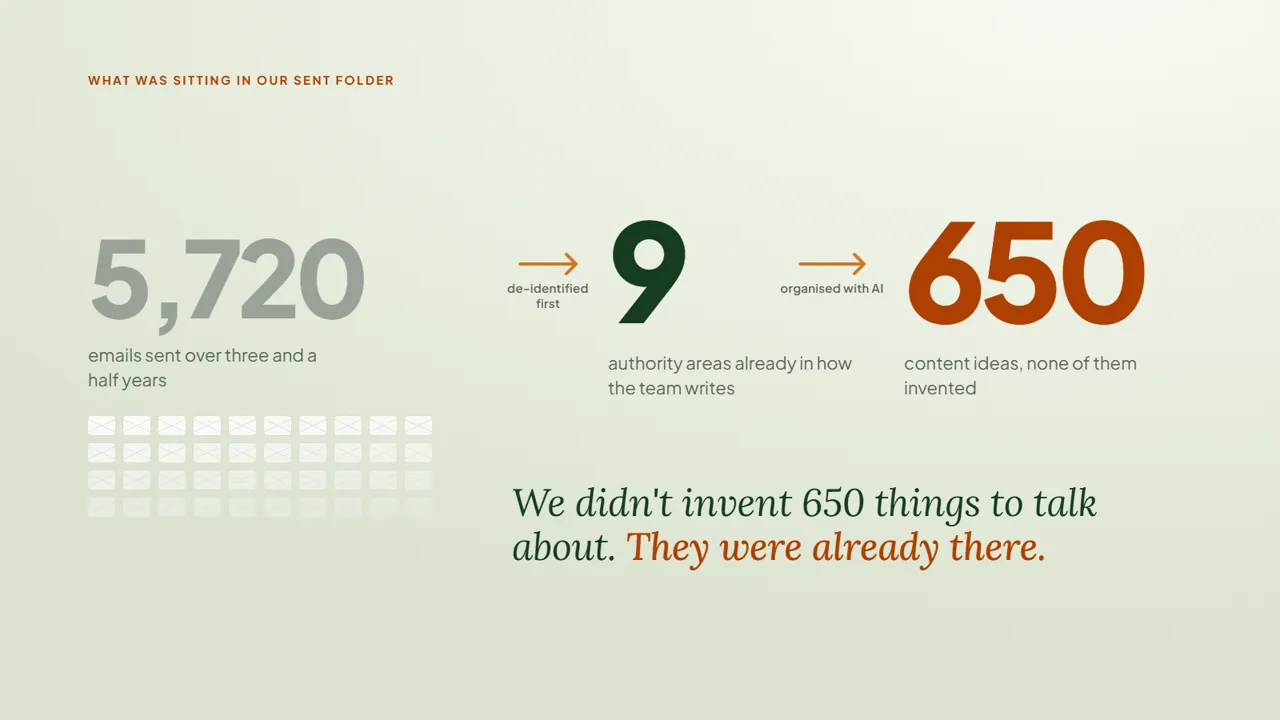
We started wondering how much useful material we'd accumulated like that without realising it. So we looked. Across roughly three and a half years, our clinic had sent around 5,720 outbound emails.
Obviously you can't just dump 5,720 clinical emails into an AI tool and ask it to "find the good stuff". Nor should you. So we built a tool whose only job was to strip out identifying information and anything relating specifically to an individual family: names, dates of birth, NDIS numbers and the rest.
What remained was the substance. The explanations. The recurring questions. The things our clinicians talked about again and again. The language they naturally used. The experiences and stories behind how we work. Only then did we use AI to help digest and organise it.
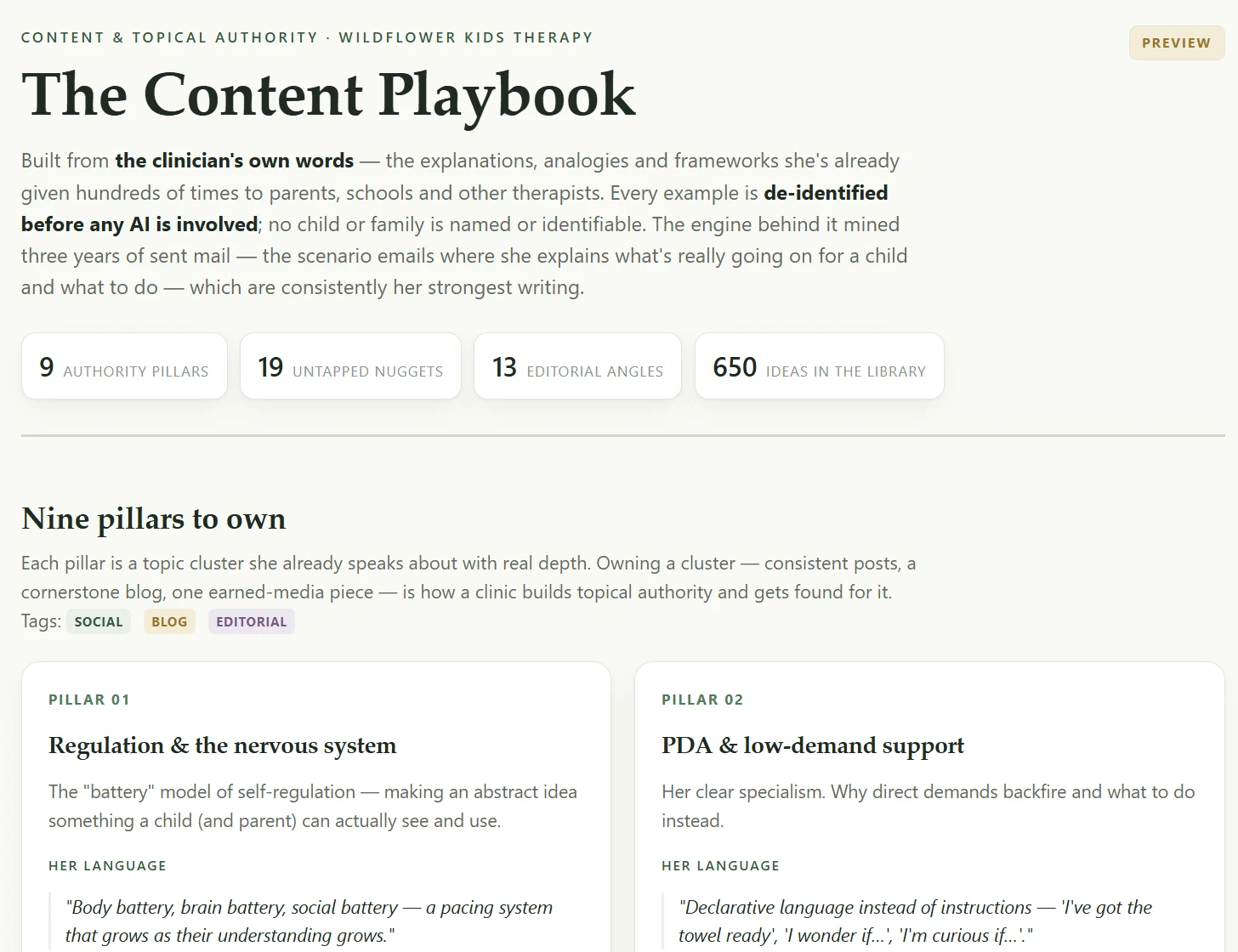
And the result genuinely surprised me. It identified nine recurring authority areas that were already woven through the way our team communicates. It surfaced subjects we'd talked about repeatedly but had never considered turning into educational content. It suggested editorial angles. And eventually we ended up with around 650 potential ideas sitting in a content library.
We didn't invent 650 things to talk about. That's the point. They were already there. We'd just buried them in the sent folder.
That matters because I think the way clinics need to think about marketing is changing. People are increasingly asking AI systems questions directly, and AI-generated answers are now showing up inside traditional search as well. There is endless generic health content online.
What you have that somebody else doesn't is your actual experience, this is what AI looks for and it's known as "Content Gain". Information that is new, specific and can not be made up.
You don't need AI to manufacture expertise, you've already got the expertise. AI can help you find it, organise it and reuse it.
That's the bit I find interesting. Full disclosure: I'm not an SEO expert. I've spent a fair bit of time researching this space and experimenting with it because there is so much to learn and it's changing every day with AI. There are some brilliant resources available around this, one is; Hawk Academy (Aussie bloke, great social content and really detailed free SEO/ AEO courses... I have no affiliation, just a big fan of people putting quality content out into the world)
We still use a marketing person. AI hasn't suddenly made me capable of producing beautiful graphics, sadly. What it has done is mean we're no longer asking somebody to somehow extract three years of ideas, experience and language from our heads every time we want to create something useful. And for clinics that struggle with the idea of "doing marketing", I think that's a much nicer place to start.
If you want to chat to me about how we set this up, feel free to book a time in my diary.